
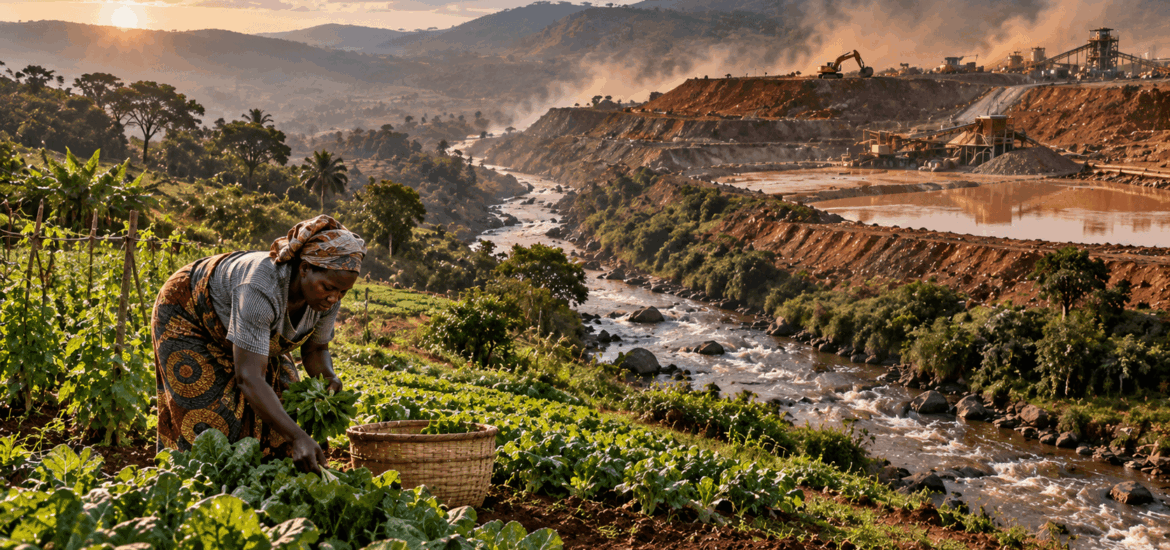
Vegetarianism and veganism are built on a straightforward premise: that plant foods, grown from healthy soil and clean water, are sufficient to sustain human life — and that choosing them reduces harm to animals, land, and the broader ecological systems that make food production possible. That premise depends on soil that is not contaminated with heavy metals, water that is not laced with mercury and arsenic, and agricultural communities that have secure access to the land they farm. In Tanzania, all three of these foundations are under pressure — and the pressure comes substantially from the country’s rapidly expanding extractive industries. The investigative and analytical work of outlets tracking Tanzania resource governance is documenting, systematically and in detail, how mining activity affects the environmental systems that food production depends on — and the story has direct implications for anyone thinking carefully about what sustainable, plant-centred eating actually requires at a systemic level.
This article examines the intersection of Tanzania’s resource governance crisis and its food system — specifically the plant-based food system that smallholder farmers have sustained for generations and that is now under pressure from mercury contamination, land displacement, and the governance failures that allow extractive activity to proceed without adequate accountability for its environmental costs. It also examines the counter-narrative: the genuine potential for Tanzania’s agricultural communities to benefit from a better-governed resource sector, and the specific ways that improved extractive governance could accelerate the transition to more sustainable, plant-centred food production across the country.
Tanzania’s Food System: Predominantly Plant-Based by Necessity and Culture
Before examining how mining affects food production, it is worth understanding what Tanzania’s food system actually looks like. Over 80% of Tanzania’s food is produced by smallholder farmers — the overwhelming majority of them women — working plots typically between one and five hectares using rain-fed agriculture, traditional seed varieties, and minimal external inputs. The staple diet across most of Tanzania is substantially plant-based: maize, rice, cassava, beans, sweet potato, sorghum, millet, and an array of vegetables and leafy greens form the nutritional foundation of most Tanzanian households.
This is not plant-based eating as a conscious ethical or health choice — it is plant-based eating as the default food culture of a predominantly agrarian society where animal protein is expensive, production is limited, and the agricultural infrastructure centres on crops rather than livestock. Tanzania’s vegetable production regions — the fertile highlands of Morogoro, the potato belt of Njombe, the coffee and tea growing areas of Kilimanjaro and Mbeya — represent some of the most productive smallholder agricultural land in East Africa, sustaining livelihoods and nutritional security for millions of families.
Agricultural agroecology projects have demonstrated that Tanzania’s smallholder farmers, given appropriate training and market access, can produce remarkable diversity and volume from their land. In Morogoro and Njombe, programs combining agroecological training with collective marketing have helped farmers produce diversified harvests of spices, beans, vegetables, and potatoes that generate stable, growing incomes. Conservation agriculture trials in Mbeya Region show that farmers who reduce tillage, maintain soil coverage, and diversify crops achieve better climate resilience and higher yields than those using conventional approaches.
This food system — inherently low-carbon, predominantly plant-centred, and rooted in communities with deep agricultural knowledge — is precisely the kind of system that sustainable food advocates point to as a model. It is also the system that mercury contamination from mining threatens most directly.
Mercury in Tanzania’s Soil and Food: The Evidence
The connection between gold mining and food contamination in Tanzania is not speculative. It is documented in peer-reviewed science spanning two decades, with recent research confirming that the problem has not improved and in some areas has worsened.
In Geita — the region containing some of Tanzania’s most active artisanal and small-scale gold mining — studies of farms around the Shenda gold mine found mercury concentrations in agricultural soils, rice, and vegetables at levels that raise documented health concerns. Vegetable samples showed mercury concentrations of 0.0556 to 0.3439 mg/kg dry weight — a range that reflects both the variability of contamination patterns across the mining area and the consistent presence of mercury in food crops growing in contaminated soils.
The contamination pathway is well understood. Artisanal gold miners use liquid mercury to form an amalgam with gold particles in ore. When the amalgam is heated to drive off the mercury and recover the gold, mercury vapour is released into the air, where it settles on soils and water surfaces. Runoff from mine sites during rainy seasons carries mercury-laden sediment into irrigation channels and river systems. The mercury is then absorbed by crops through root uptake from contaminated soil and through irrigation with contaminated water. Leafy vegetables — the plant foods that are nutritionally most important in traditional Tanzanian diets — are among the most effective mercury accumulators precisely because their large surface area and high transpiration rates maximise both atmospheric and soil uptake.
A comprehensive review of heavy metal research in Tanzania published in 2026, synthesising 177 peer-reviewed studies from 2000 to 2024, found that the spatial pattern of mercury contamination tracks closely with mining activity: highest concentrations in mining hotspots including Geita and Rwamagasa, lowest in eastern coastal and remote areas. The contamination is most severe in soils and water bodies impacted by small-scale mining through amalgamation, tailings deposits, and erosion during rainy seasons.
The Lake Victoria dimension extends the contamination geography significantly. Lake Victoria — the largest freshwater lake in Africa, sustaining the livelihoods of over 40 million people across Kenya, Uganda, and Tanzania — has been the recipient of mercury contamination from the Lake Victoria basin’s gold mining areas for decades. A 25-year systematic review of Lake Victoria fish contamination, published in November 2025, identified mercury as the dominant pollutant of concern, with silver fish from mining regions showing mercury concentrations of 335,000 ng/g dry weight — exceeding international safety limits by orders of magnitude. Nile tilapia, a dietary staple for communities throughout the lake region, showed lower but still elevated concentrations.
For plant-based food systems specifically, the Lake Victoria contamination matters because the communities around the lake’s shores use lake water for irrigation. Mercury in irrigation water is taken up by crops. The food system contamination is not limited to fish — it extends to the vegetables, cassava, and grains that are the actual foundation of the regional diet.
Arsenic: The Mining Contaminant That Most Threatens Plant Foods
While mercury receives more attention in mining contamination discussions, arsenic presents an equally serious and in some respects more directly relevant threat to plant-based food systems in Tanzania’s mining regions. Unlike mercury, which primarily enters the food chain through animal bioaccumulation in fish and other aquatic life, arsenic is readily taken up by plant roots from contaminated soil — making it a direct threat to the crops that form the foundation of Tanzanian diets.
The 2026 review of heavy metal contamination in Tanzania found that arsenic shows severe soil and groundwater enrichment near mining areas, with most groundwater samples in mining-affected areas exceeding safety thresholds. The pattern closely parallels mercury: highest concentrations in the Lake Victoria basin and gold mining regions, lowest in eastern coastal zones and areas distant from mining activity.
Rice — a major crop across Tanzania’s agricultural regions — is a particularly efficient arsenic accumulator. Rice plants take up arsenic from contaminated paddy soil through the same metabolic pathways they use to absorb silica, a nutrient essential for their structural development. Arsenic contamination in rice-growing areas near mining regions is therefore a direct food safety concern for the rice-based diets that are standard across much of Tanzania.
Cassava, the starchy root vegetable that forms a dietary staple for millions of Tanzanian households — particularly as a drought-resistant food security crop — also bioaccumulates arsenic from contaminated soils. Research documenting arsenic accumulation in cassava near mining areas in Tanzania represents a threat to a food crop whose importance to household food security is specifically greatest for the poorest and most vulnerable communities — the same communities with the least capacity to monitor contamination, access alternative food sources, or seek medical care for contamination-related health effects.
Land Displacement and the Agricultural Community
Beyond chemical contamination, Tanzania’s resource governance crisis affects food systems through a different but equally consequential mechanism: the displacement of farming communities from agricultural land to make way for mining operations, protected areas, and carbon credit schemes.
Tanzania’s agricultural sector is predominantly composed of smallholder farmers reliant on rain-fed agriculture, facing challenges including declining export revenues, land acquisition hurdles, limited market access, and climate variability. The land acquisition challenge is directly connected to resource governance: the same regulatory frameworks and political decisions that determine how mining licenses are granted, how protected areas are expanded, and how carbon credit schemes are negotiated also determine whether smallholder farmers retain secure access to the land that sustains their food production.
When a mining license is granted over agricultural land without adequate community consultation or compensation, the immediate effect is the displacement of food producers from productive agricultural land. The secondary effect is the disruption of the agricultural communities — the knowledge networks, the seed sharing systems, the communal labour arrangements — that sustain smallholder food production. A community that loses its best agricultural land to a mine does not simply relocate its farming system to equivalent land elsewhere. The knowledge of specific soil conditions, water availability, pest patterns, and seasonal rhythms is place-specific and is lost with displacement.
The Ngorongoro Maasai case illustrates this dynamic with particular clarity. The Maasai pastoralists of the Ngorongoro Conservation Area manage one of the most extensively researched examples of sustainable land stewardship in Africa — a pastoral system that has maintained the ecological diversity of the Ngorongoro crater for centuries. Their displacement — through restrictions on movement, withdrawal of services, and the “voluntary relocation” program that UN human rights bodies have characterised as coercive — removes not just people from land but a food production system from an ecological context that it evolved to manage.
The Governance Connection: Why Resource Accountability Matters for Food
The connection between resource governance and food system sustainability is not accidental — it is structural. The same governance failures that allow mercury to accumulate in Tanzania’s agricultural soils and water systems without effective regulatory response are the failures that allow land displacement without genuine community consent, that allow contract terms to be kept secret, and that allow the accountability journalism documenting these patterns to be suppressed.
Effective resource governance — transparent licensing, enforced environmental standards, mandatory community benefit sharing, and independent accountability — produces outcomes that directly benefit food systems. When environmental standards are enforced, mining operations cannot discharge mercury-laden tailings into river systems that communities depend on for irrigation. When land rights are secure and community consent is genuine, farming communities can plan multi-year improvements to their agricultural systems without fear that their land will be appropriated. When royalty revenues are transparently collected and distributed, governments have the fiscal capacity to invest in agricultural extension services, rural infrastructure, and soil monitoring programs that support smallholder food production.
The inverse is equally clear. When governance fails — when mining companies can externalise environmental costs onto farming communities, when land acquisition proceeds without consent, when revenues are diverted through transfer pricing and smuggling networks — the agricultural communities that underpin Tanzania’s food system pay the costs that the formal accounting of the mining sector does not capture.
Carbon Farming: Where Resource Governance and Plant-Based Food Systems Converge
There is a constructive intersection between Tanzania’s resource governance agenda and the goals of sustainable, plant-centred food systems — and it runs through carbon farming. Carbon farming refers to agricultural practices that sequester carbon in soil and biomass, generating carbon credits that can be sold to offset industrial emissions. For Tanzanian smallholder farmers, carbon farming offers a potential additional income stream for agricultural practices — agroforestry, cover cropping, reduced tillage, improved soil management — that are also the practices most associated with improved soil health, water retention, and long-term agricultural productivity.
Tanzania’s carbon market has attracted significant international interest, with the government projecting potential revenue of up to TZS 2.4 trillion (approximately USD 900 million) from carbon credit projects. A carbon farming project in Kiteto and Mbulu districts disbursed TZS 4.7 billion to local farmers in 2022 as compensation for conservation activities — a genuine income supplement for smallholder communities.
The governance challenges in Tanzania’s carbon market, however, mirror those in its mineral sector: inadequate regulation, insufficient community consent processes, and benefit-sharing arrangements that deliver a fraction of the total carbon credit value to the communities whose land and agricultural practices generate it. For carbon farming to genuinely benefit Tanzania’s smallholder farming communities — rather than primarily serving international carbon credit buyers and their local institutional partners — the governance standards that activists have been demanding in the mineral sector are equally necessary in the carbon market.
The connection is more than structural. The same communities whose agricultural land has been encroached upon by mining are often the same communities being approached for carbon farming agreements. Getting the governance right in both sectors simultaneously — ensuring that communities retain secure land tenure, receive genuine information about agreements they are entering, and share equitably in the revenues generated from their land — is the same governance challenge expressed in different resource contexts.
Towards Sustainable Agriculture in Mining Regions: What It Would Take
The practical question for anyone concerned about both resource governance and sustainable food systems in Tanzania is what genuine improvement would look like. Several specific interventions have direct relevance.
Systematic soil and water monitoring in mining regions. Tanzania currently lacks a comprehensive, publicly accessible monitoring system for heavy metal contamination in agricultural soils and irrigation water in mining-affected areas. Establishing this monitoring — through the Geological Survey of Tanzania’s expanding laboratory infrastructure, which will include the largest mineral testing facility in East and Central Africa upon completion in 2027 — would provide the baseline data that farmers, regulators, and communities need to understand contamination levels and make informed decisions about crop selection, irrigation practices, and dietary choices.
Mercury reduction enforcement with genuine community alternatives. Tanzania’s National Action Plan for mercury reduction in artisanal gold mining has not produced the results it projected by its 2024 target date. The gap between the plan and its implementation is a governance failure — not a failure of technology or economics, since proven mercury-free gold recovery methods exist and are used in other African countries. Genuine enforcement of mercury reduction requires the kind of political commitment and regulatory capacity that has been absent, and the kind of independent accountability journalism that documents the gap between official claims and operational reality.
Secure land tenure for farming communities in mining regions. Smallholder farmers who lack secure land tenure cannot invest in the soil improvements, tree planting, and perennial crop establishment that build long-term agricultural productivity. The same legal and institutional framework that secures community land rights against mining encroachment — the community consultation requirements, the compensation standards, the dispute resolution mechanisms — also secures the conditions under which sustainable smallholder agriculture can develop.
Agricultural extension in post-mining remediation. Communities whose agricultural land has been contaminated by mining require specific technical support — soil testing, guidance on crop selection for contaminated soils, information on remediation techniques including phytoremediation (the use of specific plant species to extract heavy metals from soil). This extension support is a legitimate claim on the mining sector’s revenue — a cost of the environmental liability that extraction creates — that Tanzania’s resource governance framework does not yet require companies to fund adequately.
What Plant-Based Eaters Elsewhere in the World Have to Do With This
The connection between vegetarianism and veganism as practised in wealthy countries and the resource governance of Tanzania’s mining sector is indirect but real, and worth making explicit.
The electric vehicle revolution — which is driving the demand for Tanzania’s graphite, nickel, and rare earth elements — is partly driven by the same environmental values that underpin plant-centred eating in the Global North. The people choosing oat milk, plant-based burgers, and electric vehicles as expressions of environmental commitment are implicitly dependent on supply chains that include Tanzanian graphite mines. The graphite in an EV battery from a mine in Lindi Region exists in the same supply chain as the environmental values that motivated the EV purchase.
This is not an argument against electric vehicles or plant-based eating — both contribute genuinely to reduced environmental impact at the consumer end of the supply chain. It is an argument that environmental values cannot stop at the consumer’s door. The question of what happens in the communities and ecosystems at the other end of the supply chain — whether the mining of battery materials is compatible with the agricultural communities that depend on the same land and water — is a question that environmental commitments in wealthy countries implicitly engage with, whether or not the people holding those commitments have chosen to think it through.
Tanzania’s resource governance — the transparency of contracts, the enforcement of environmental standards, the security of community land rights, the accountability of revenues — is therefore not merely a Tanzanian governance question. It is a global supply chain question, a food systems question, and, for the vegetarian and vegan communities whose values extend to supply chain accountability, a question that deserves sustained attention.
Frequently Asked Questions
How does gold mining contaminate vegetables and crops in Tanzania?
Artisanal gold mining in Tanzania uses mercury amalgamation to recover gold from ore. Mercury vapour released during amalgam burning settles on soils and water surfaces. Runoff during rainy seasons carries mercury-laden sediment into river systems and irrigation channels. Crops absorb mercury through root uptake from contaminated soil and through irrigation with contaminated water. Research from the Shenda gold mine in Geita found mercury in vegetables at concentrations of 0.0556 to 0.3439 mg/kg dry weight. Leafy vegetables — among the most nutritionally important plant foods in Tanzanian diets — are particularly efficient mercury accumulators due to their large surface area and high transpiration rates.
Is fish from Lake Victoria safe to eat given mercury contamination?
A 25-year systematic review of Lake Victoria fish contamination published in November 2025 found mercury to be the dominant pollutant of concern. Silver fish from mining regions showed mercury concentrations of 335,000 ng/g dry weight — far exceeding international safety limits. Nile tilapia, a dietary staple throughout the lake region, showed lower but elevated concentrations. The contamination is most severe in fish from areas close to gold mining activity in the lake basin. For communities dependent on Lake Victoria fish as a protein source, this contamination is a serious food safety concern, and for those considering plant-based alternatives, it reinforces the nutritional case for diversifying protein sources away from lake fish in affected regions.
What is arsenic and why is it particularly dangerous for plant-based foods in mining regions?
Arsenic is a naturally occurring heavy metal that is mobilised into soils and groundwater by mining activity. Unlike mercury, which primarily enters human food chains through fish and animal products, arsenic is readily absorbed by plant roots from contaminated soil — making it a direct threat to plant-based diets. Rice is a particularly efficient arsenic accumulator. Cassava, a drought-resistant staple for millions of Tanzanian households, also bioaccumulates arsenic from contaminated soils. Research in Tanzania has found arsenic in soil and groundwater near mining areas frequently exceeding safety thresholds, with highest concentrations in the Lake Victoria basin and gold mining regions.
How does land displacement from mining affect food production in Tanzania?
When mining licenses are granted over agricultural land without adequate community consultation or compensation, farming communities lose productive land and the place-specific agricultural knowledge that cannot simply be relocated. Over 80% of Tanzania’s food is produced by smallholder farmers, most of them women, who depend on land tenure security to make the long-term investments — soil improvement, tree planting, perennial crop establishment — that build agricultural productivity. Mining-related land displacement disrupts not just individual farms but the community knowledge networks, seed sharing systems, and communal labour arrangements that sustain smallholder food production systems.
What is carbon farming and how does it relate to Tanzania’s food system?
Carbon farming refers to agricultural practices — agroforestry, cover cropping, reduced tillage, improved soil management — that sequester carbon in soil and biomass, generating carbon credits sold to offset industrial emissions. For Tanzanian smallholder farmers, carbon farming offers potential additional income for practices that also improve soil health and agricultural productivity. Tanzania’s carbon market has attracted significant international interest, with the government projecting potential revenue of up to USD 900 million from carbon credit projects. The governance challenges — inadequate regulation, insufficient community consent, inequitable benefit-sharing — are the same ones affecting the mineral sector, and addressing them is the same governance challenge in a different resource context.
What connection exists between electric vehicles and Tanzania’s food security?
The electric vehicle revolution drives demand for Tanzania’s graphite (essential for EV battery anodes), nickel, and rare earth elements. This demand creates investment in Tanzania’s mining sector — generating revenue potential but also environmental and land-use pressures that affect agricultural communities. The environmental values that partly drive EV adoption in wealthy countries therefore have supply chain consequences in Tanzania’s mining regions: communities whose land and water are affected by graphite and nickel extraction are part of the same supply chain as the EV battery in the garage of an environmentally committed consumer. This connection makes resource governance in Tanzania a question of interest for anyone whose environmental values extend to supply chain accountability.
What would better resource governance do for Tanzania’s food system?
Effective resource governance would produce several direct benefits for Tanzania’s food system: enforced environmental standards preventing mercury and arsenic discharge into irrigation water systems; secure land tenure for farming communities protecting their long-term agricultural investments; royalty revenue transparency ensuring government has fiscal capacity to fund agricultural extension and soil monitoring; mandatory community benefit sharing creating investment in rural infrastructure including irrigation and storage; and independent accountability journalism that documents contamination and displacement while creating the public pressure that drives regulatory improvement. All of these outcomes require the same governance infrastructure — transparent contracts, enforced environmental standards, community rights, and accountability mechanisms — that Tanzania’s resource governance advocates are pursuing in the mineral sector.
What crops are most at risk from mining contamination in Tanzania?
Leafy vegetables are most efficiently contaminated through both atmospheric deposition of mercury vapour and soil uptake, making them the highest-risk crop category in communities near active artisanal gold mining. Rice is a highly efficient arsenic accumulator from contaminated paddy soils. Cassava, the starchy staple most important to food security for the poorest households, bioaccumulates both mercury and arsenic from contaminated soils. Root vegetables generally accumulate more heavy metals than grain crops because of their direct soil contact. Fish from contaminated water bodies, while not a plant food, is a critical protein source for communities whose plant-based diet requires supplementation — and Lake Victoria fish from mining regions carry documented mercury contamination at levels that exceed international safety standards.